



MoSPI, Tripura Govt and UNDP Host Workshop on Strengthening Sub-National SDG Monitoring
Shri Rajiv Sen, Senior Advisor at NITI Aayog, stressed the importance of institutional capacity building and effective implementation of schemes through structured SDG monitoring.
- Country:
- India
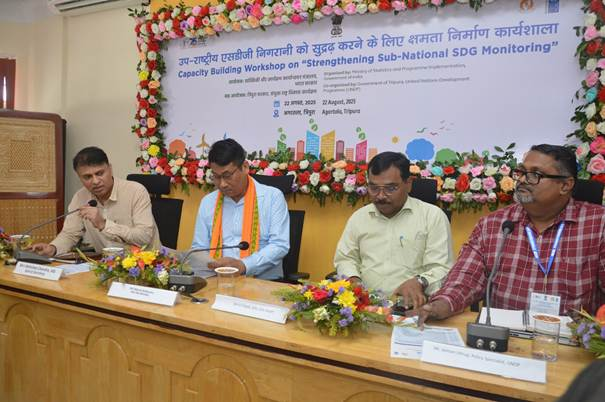
The Ministry of Statistics and Programme Implementation (MoSPI), Government of India, in collaboration with the Government of Tripura and the United Nations Development Programme (UNDP), organized a Capacity Building Workshop on ‘Strengthening Sub-National SDG Monitoring’ in Agartala, Tripura on 22 August 2025. The event brought together representatives from several States and Union Territories that are still in the early stages of developing their own State/UT Indicator Frameworks (SIFs/UTIFs) for tracking progress towards the Sustainable Development Goals (SDGs).
Inaugural Session and Key Addresses
In his inaugural address, Shri Bikash Debbarma, Hon’ble Minister, Planning (Statistics) Department, Government of Tripura, emphasized the importance of adopting a whole-of-government approach for SDG implementation. He noted that the SDGs are not only a roadmap for global development but also a practical tool to enhance socio-economic conditions, particularly focusing on women, children, and vulnerable communities.
Delivering the keynote address, Shri S.C. Malik, Additional Director General, MoSPI, underscored the need for localized action, continuous monitoring, and timely data collection to achieve the 2030 Agenda for Sustainable Development. He explained how MoSPI has developed the National Indicator Framework (NIF), which serves as the backbone for States and Union Territories to design their own monitoring frameworks. Stressing the importance of granular, high-quality data, Shri Malik highlighted that monitoring is not an end in itself but a means to improve development outcomes, ensure inclusivity, and reach the most vulnerable populations. He also reaffirmed MoSPI’s commitment to working with States, line ministries, and development partners to strengthen India’s SDG monitoring ecosystem.
Shri Rajiv Sen, Senior Advisor at NITI Aayog, stressed the importance of institutional capacity building and effective implementation of schemes through structured SDG monitoring. This was followed by a special address from Shri Abhishek Chandra, Special Secretary, Planning (Statistics), Government of Tripura, who reiterated the state’s commitment to advancing the 2030 Agenda by building robust state-level data systems and ensuring localized monitoring.
On behalf of UNDP, Mr. Jaimon Uthup, Policy Specialist, emphasized UNDP’s long-standing partnership with the Government of India and States/UTs in developing robust statistical systems, technical capacity, and inclusive monitoring mechanisms to accelerate SDG achievement.
Technical Presentations and Knowledge Sharing
Ms. Saumya Sakshi, Joint Director, MoSPI, and Mr. Abhishek Gaurav, Deputy Director, MoSPI, presented a detailed overview of the monitoring mechanisms for SDGs in India, particularly focusing on the NIF and Sub-National Indicator Frameworks. MoSPI reminded participants that States and UTs bear the primary responsibility for sub-national monitoring of SDGs, as emphasized in its 2019 guidelines for States/UTs. These guidelines, updated in March 2022, were published as the report “Guidance on Monitoring Framework on SDGs at the Sub-National Level” and circulated to all States and UTs to aid in developing State Indicator Frameworks (SIFs).
The UNDP team highlighted global best practices in SDG monitoring, with a particular focus on localization and community-level inclusion. Sharing a practical perspective, Shri Chiranjib Ghosh, Joint Director, Directorate of Economics and Statistics, Tripura, elaborated on Tripura’s own journey in designing its State Indicator Framework (SIF), underlining challenges and lessons learned.
Interactive Technical Sessions
The workshop also featured interactive group exercises where participants assessed the status of their respective States and UTs in SDG monitoring. These sessions aimed at:
-
Identifying relevant indicators for each SDG at the sub-national level.
-
Drafting preliminary frameworks tailored to State/UT contexts.
-
Assigning departmental responsibilities to ensure accountability.
-
Prioritizing key indicators based on local developmental needs.
-
Formulating state-specific action plans aligned with national priorities.
-
Integrating cross-cutting issues such as gender equality and climate action into their frameworks.
Call to Action and Way Forward
The workshop concluded with a strong call to action for all participating States and UTs to strengthen their sub-national SDG monitoring frameworks in alignment with the National Indicator Framework (NIF). Participants reaffirmed their collective commitment to evidence-based policymaking, better data ecosystems, and inclusive monitoring to ensure India remains on track to achieve the 2030 Agenda.
The event highlighted how coordinated efforts between the Government of India, States/UTs, and international partners like UNDP are critical in ensuring that the promise of the SDGs translates into tangible improvements in people’s lives at the grassroots level.


 Google News